

Unfortunately, becoming AI-native is a lot like getting fit.
Small behaviors, repeated consistently, matter more than grandiose displays of brilliance.
Almost no company gets a blank page.
Existing companies inherit an org chart, job architecture, approval chains, technology debt, budget cycles, and management layers built to move information from the people who have it to the people permitted to act on it.
Then they attempt to become “AI-native” without disturbing any of it.
We do not have that excuse.
We’re building Now to Next from the ground up while advising other companies on AI strategy, work redesign, and operating models. We have the rare privilege of starting with almost nothing—a true blank page—and therefore, I believe, an obligation to show our work.
Not just where we get it right, but where we remain stubbornly pre-AI.
It happens more easily than you might realize. Our old instincts drag us backward. Some of the tools disappoint us or prove far less dazzling in everyday use. Claude Design, I’m looking at you. Radical openness sometimes creates ambiguity. Wearing multiple hats can be liberating, but it can also be too much.
I recently read Elena Verna’s account of working inside Lovable, the first company she would describe as genuinely AI-native. Her distinction is important: AI-native does not simply mean everyone uses AI a lot.
It means the organization itself begins to change around the assumption that AI is present:
What jobs look like.
How decisions get made.
How information moves.
Who is allowed to act.
What experience means.
What being good at your job means.
What Different Actually Looks Like
We work in shared enterprise spaces across Claude, ChatGPT, Notion, Google, and Slack, with broad visibility into projects, capabilities, and work in progress.
We run a fleet of agents that scans email for progress, updates, and signals of potential new business; creates opportunities in HubSpot; applies updates across systems; and examines our work for ways to strengthen our shared IP and templates.
I can talk to Claude from Slack. I can retrieve Notion context through Claude. Drive captures the work we create wherever we create it. The tools do not operate as separate destinations that humans must constantly visit, reconcile, and update. They form a connected operating environment.
Every tool talks to every other tool.
Let’s borrow from one of our favorite quips: “It’s 2026 outside of work. What year does it feel like inside of work?” So from that perspective, let’s say someone working in a 2005-”feeling” company, almost every connection between those systems would have been a person.
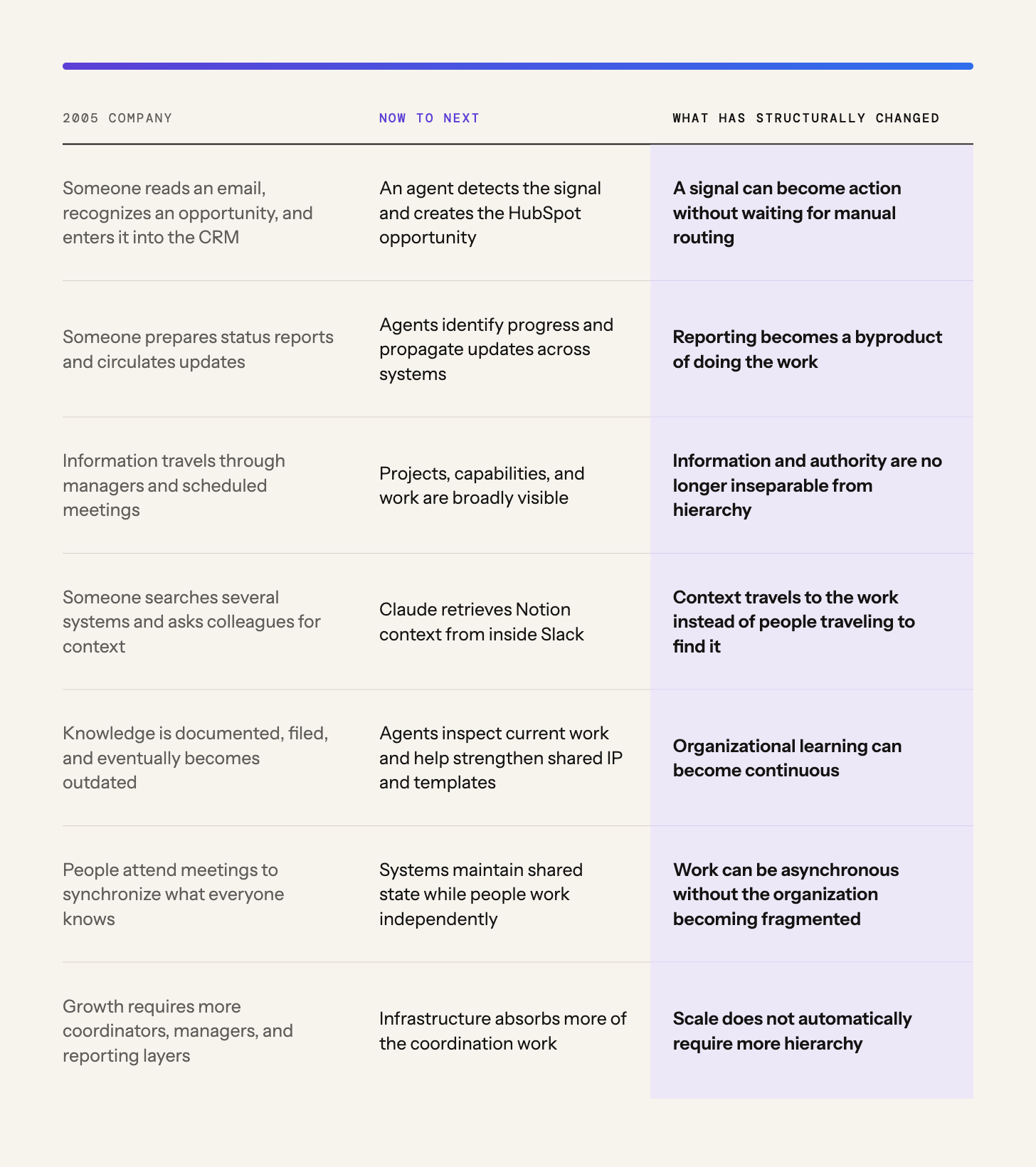
See what’s happening here? This isn’t simply individual productivity improvement (what most AI “gains” can reliably report).
Rather, we are making handoffs computational. Work updates the systems. The systems inform the work. Context moves without waiting for a meeting, a manager, or a person assigned to carry it from one application to another.
I think of it as synchronized asynchronous work.
People can move independently without causing the company to fragment because the shared context continues to move with us. Meetings and managers are no longer solely responsible for keeping the organization in a common state.
We are not simply completing individual tasks faster.
We are collapsing the organizational distance between signal and action.
That may be the most important difference between adding AI to a company and building a company around the assumption that AI exists.
When Flatness Becomes a Consequence
Patrick Dodge recently observed something else while watching Jason and me operate in Slack.
He said we appeared to be building a flat organization almost by default—not because we had declared flatness as a principle, but because everyone uses AI, everyone can wear multiple hats, and everyone is expected to own an outcome.
My answer to Patrick was simple:
I care less about who owns an individual workflow than I do about who owns the outcome.
When we hired Aidan and Macrae, I rejected narrow job descriptions. I wanted outcome owners.
Anyone can contribute to anything. Sometimes the contribution is better, more novel, or more creative precisely because the person is not a subject-matter expert in how it has always been done.
The rest of us have to work to forget what we already know. We have to consciously apply first-principles thinking and resist defending the familiar way of doing something. Clean-slate thinking comes more naturally when someone approaches a problem with hungry curiosity, critical thinking, research, and an obsession with the outcome—not an attachment to the method.
Everyone should have access to everything.
Claim the work. Clarify the accountability. Know the outcome. Drive toward it.
The speed of innovation becomes a massive unlock in this kind of structure. That’s how a 22-year-old can suddenly find herself doing work many companies would reserve for a CMO.
Patrick pushed the observation further: if you do not build in administrative heft, you need less verticalization. You need fewer layers devoted to coordinating, translating, assigning, and monitoring work. People can simply own the outcome.
Flatness, in that case, is not a cultural preference.
It is a consequence of redesigning work.
Patrick also mapped the organizational proxies this begins to challenge:
Headcount as power.
Title as value.
Activity as performance.
Information scarcity as leverage.
Management as coordination.
Reorganization as adaptation.
It challenges “experience” itself, too.
Nobody has 20 years of experience operating this way. Some of the most senior people in business are defending authority earned under conditions that no longer exist. Meanwhile, a younger person working in an AI-native, outcome-owned model may accumulate the breadth of ten years of conventional experience in three.
That doesn’t mean hierarchy disappears because we said so. It certainly does not mean titles, expertise, structure, or management have no value. And it definitely doesn’t mean we have solved the operating model for the AI era.
We haven’t.
But we have the chance to examine every convention before carrying it forward.
Does this role need to exist?
Does this decision need a meeting?
Does this information need an owner, or does everyone need access?
Does this work require more management, or simply a clearer outcome?
Are we using AI to improve a process that should be eliminated altogether?
Those are the questions we ask other organizations. They are hard enough to answer. The answers become much harder to execute as an organization grows and the structures holding it become more calcified.
What We Are Still Learning
It feels important to let people see how imperfectly we answer these questions ourselves.
We have had to literally remind ourselves to stop drafting standardized job descriptions and define outcomes instead—then build capability profiles around the different ways those outcomes might be achieved.
We spend more time than you might think clarifying RACI, decision rights, and accountability so approvals do not quietly become bottlenecks.
And we obsess over ways of working. If everyone needs access to everything—so ideas travel, we ship faster, and what we build can scale—the infrastructure beneath that openness has to be rock solid.
Because removing friction does not remove the need for accountability.
It makes accountability more consequential.
If an agent can detect an opportunity, create a record, update several systems, and trigger downstream work, a mistake can travel just as quickly as a good decision. Permissions, data provenance, human-review thresholds, audit trails, agent ownership, and failure containment cannot be afterthoughts.
Traditional organizations often use bureaucracy as a crude form of risk control.
The real design challenge is removing the bureaucracy without removing the control.
For a CHRO, this creates a profound shift: the org chart is no longer the primary architecture through which work happens.
The real operating model is becoming the network of context, capabilities, permissions, agents, integrations, decision rights, and accountability underneath it.
A job description can tell you where someone sits. It cannot adequately tell you:
What outcomes they can own.
What capabilities they can contribute elsewhere.
What information they can access.
What decisions they can make.
What agents they supervise.
How their work changes the rest of the system.
This is why AI transformation is not ultimately a technology-adoption exercise.
It is organizational design.
If companies add agents while preserving every meeting, approval, handoff, reporting ritual, managerial layer, and information boundary, they may automate individual tasks without changing how the organization moves.
The more important question is:
What coordination work existed only because our systems could not share context, our people could not see across boundaries, and authority had to travel through hierarchy?
That is where the real transformation begins.
Not with one brilliant prompt, a fleet of agents, or a grand declaration that the company has transformed. It happens through hundreds of small operating choices: what you define, what you question, what you make visible, what you automate, what you stop protecting, and what you refuse to carry forward simply because companies before yours did.
Like fitness, the transformation is in the reps.
In the old operating model, people connected the systems. In an AI-native company, the systems connect the people.
Keep watching. We’re an open book, and we’re in the trenches with organizations doing this every single day.
More Notes from the Blank Page soon.
About Jess Von Bank
Jess Von Bank brings more than 20 years of experience across recruiting, talent strategy, employer branding, HR technology, and workforce transformation. She began as a recruiting practitioner before moving into leadership roles focused on bringing workforce solutions to market, including global HR transformation and technology advisory work at Mercer. She is now co-founder of Now to Next, where she combines industry expertise, community building, storytelling, and a human-centered perspective on change.
Just listened to this (love consuming that way, btw). Lots of great things to consider in here. I’d add that one of things I find what makes this journey feel approachable is the fact that it does mirror a fitness journey, in that it’s in the reps and the small habits. That makes it much less daunting to me. And that’s what I preach to people I talk to about where to start if they’re stuck. Don’t go searching for the golden goose, moon shot solution. Find a pain point, identify if it’s worth fixing or eliminating and, if it’s worth fixing, let’s bring in AI to see where it can help. I think that alleviates so much of the ambiguity in where to begin. I appreciate that you can start without having all the answers.